
Choosing a siding contractor in Texas is harder than it should be, because the same weather that damages siding also fills the state with contractors chasing that damage. Texas has led the nation in hail losses for over a decade, and after every major storm, out-of-state crews flood the hardest-hit metros to sign jobs fast and leave before the work can be judged. The good news: Texas is unusually transparent about contractor records, and a homeowner who runs a few checks can separate the crews worth calling from the ones to avoid. This guide walks through exactly how. Call Us Now to reach a siding contractor serving your area.
The short answer
Hire a siding contractor who carries general liability insurance and shows proof on request, has a verifiable local track record rather than a storm-season address, gives a written scope covering the wall system and not just the panels, and does not pressure you to sign on the first visit. Texas does not license siding contractors at the state level, so the burden of vetting falls on you — the checks below are how you carry it.
Texas does not license siding contractors — what that means
Texas has no statewide license for siding, roofing, or general remodeling contractors. There is no state board to check, no license number to verify, and no exam a siding installer must pass. Some cities require a local registration or permit for exterior work, but that varies by municipality and is not a quality guarantee.
This matters for two reasons. First, "licensed" in a Texas siding ad usually means a local business registration, not a state credential, so the word alone tells you little. Second, because there is no license to lose, the real accountability comes from insurance, a paper trail, and reputation. Those are the things to check, and they are checkable.
Insurance is the one non-negotiable
A siding contractor working on your home should carry general liability insurance, and should carry workers' compensation or a documented alternative if they bring a crew. Liability insurance covers damage to your property during the job; without it, a cracked window, a damaged roofline, or water intrusion from an open wall becomes your problem. Workers' comp matters because Texas does not require most private employers to carry it, which means an uninsured worker injured on your property can, in some cases, come back on the homeowner.
Ask for a certificate of insurance, and ask for it to be sent directly from the insurer or agent rather than handed to you as a printout. A current certificate names the coverage, the limits, and the dates. A contractor who hesitates here is telling you something.
The storm-chaser problem in Texas
Because Texas hail is so reliable, a whole category of contractor follows it. After a big storm in Dallas-Fort Worth, Austin, or Houston, crews with out-of-state plates and temporary local numbers canvass the damaged neighborhoods, offer to "handle the insurance," push for a signature that day, and move on when the season ends. When the siding fails two years later, the company is gone.
The warning signs are consistent. Watch for a contractor who knocks on your door unsolicited after a storm, pressures you to sign immediately, offers to cover or absorb your insurance deductible (which is insurance fraud in Texas), asks for a large payment up front before any work, or cannot give you a local physical address and a history of local jobs. None of these on its own proves bad faith, but together they are the profile of a crew that will not be around for the warranty.
What a real local track record looks like
A siding contractor worth hiring leaves a trail you can follow. Look for a business with a consistent name and physical address over several years, verifiable reviews across more than one platform rather than a single burst of five-star reviews in one month, and local references for siding jobs specifically — not just roofing or general remodeling. Texas also makes court and business records accessible, so a contractor with a pattern of liens, unresolved complaints, or lawsuits over unfinished work is visible to anyone who looks.
The Better Business Bureau, county records, and the Texas Attorney General's consumer complaint records are all public. A ten-minute search before you sign is worth more than any yard sign.
Get the scope in writing — and make it cover the wall, not just the panels
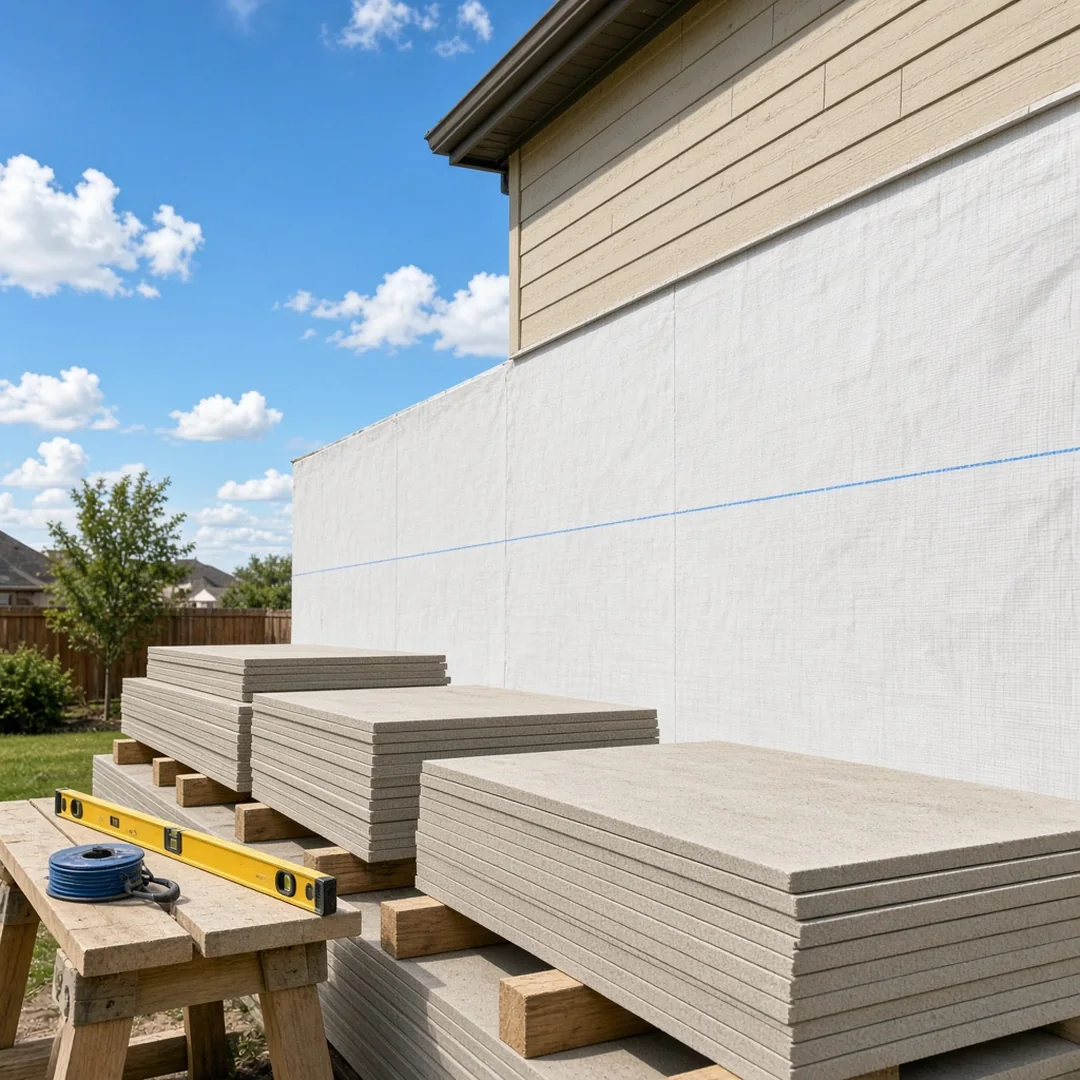
The single biggest difference between a lasting siding job and a failure is what happens behind the panels, and that is exactly what a thin bid leaves out. A proper written scope for a Texas siding job should specify the material and profile being installed, the removal and disposal of the old siding, inspection and repair of the sheathing underneath, the water-resistive barrier and house wrap, flashing at every window, door, and penetration, trim and corners, and cleanup including nail and debris removal. In Texas humidity and storm-driven rain, the flashing and drainage detail is what keeps water out of the wall — a crew that does not mention it is quoting a cover-up, not a siding job.
Get this in writing before any work starts, and make sure the written document matches what the salesperson promised out loud.
Understand the two warranties — and what voids them
A siding job carries two separate warranties, and homeowners frequently confuse them. The manufacturer warranty covers the product itself — fiber cement boards, for example, carry long product warranties against defects. The workmanship warranty is the contractor's own promise to stand behind the installation, and it is only as good as the contractor's willingness and ability to honor it, which is why a transient crew's warranty is worthless the day they leave the state.
Two things are worth knowing. First, many manufacturer warranties depend on correct installation, so a botched install can void the very product warranty you paid extra for. Second, get the workmanship warranty in writing with a stated length, and confirm the company will still exist to honor it — a long written warranty from a crew with no verifiable local history is a piece of paper, not protection.
Manufacturer certifications and why they matter
Some manufacturers run contractor certification programs — James Hardie's Preferred and Elite Preferred designations are the most visible in Texas fiber cement work. These are not government credentials, and their absence does not condemn a contractor, but a current certification signals that the installer has met the manufacturer's training and installation standards and can register the full product warranty. On a high-value home or a large re-side, a certified installer gives you a cleaner warranty path and a manufacturer relationship to fall back on. Confirm any claimed certification directly with the manufacturer, since the badge is easy to display and harder to actually hold.
How to verify a Texas contractor's record
Texas makes more of this public than most states, so use it before you sign:
- The Better Business Bureau for complaint history and how a company responded to complaints — the response pattern tells you more than the star rating.
- County clerk records for mechanic's liens and lawsuits, which reveal a pattern of jobs that ended in disputes.
- The Texas Attorney General's consumer complaint records, which capture deceptive-practice complaints.
- Reviews across more than one platform, read for a steady history rather than a single burst of five-star entries in one month.
- The insurer or agent directly for the certificate of insurance, rather than a printout the contractor hands you.
The Texas rule worth knowing: HB 2439
Since House Bill 2439 took effect in 2019, Texas cities can no longer require a specific exterior cladding material on a home. Before the law, some municipalities effectively mandated brick or masonry on new builds. Now the choice is yours. A good contractor will walk you through which material fits your home's sun exposure, your neighborhood, and your budget, rather than defaulting to one product. A contractor who insists there is only one acceptable material, or who will not explain the trade-offs, is selling inventory, not advice.
Questions to ask before you sign
- Are you insured for general liability, and can your insurer send me a current certificate directly?
- Do you have a local physical address and siding jobs in my area I can look at or verify?
- Does your written scope include the house wrap, flashing, and sheathing inspection, or only the panels?
- Which siding material do you recommend for my home's exposure, and why that one?
- What is the payment schedule, and how much is due before work begins?
- Who handles the permit if my city requires one for exterior work?
A contractor who answers these plainly is one worth considering. Call Us Now to reach a siding contractor in your part of Texas.
Call Us Now for a Siding Contractor in Texas
Once you know what to check, the next step is talking to a contractor who can pass those checks. Siding Pros TX helps you reach siding contractors serving your part of Texas for installation, repair, and replacement. Call Us Now to get started, or see siding contractors in Texas for how the work is done and which material fits your home.